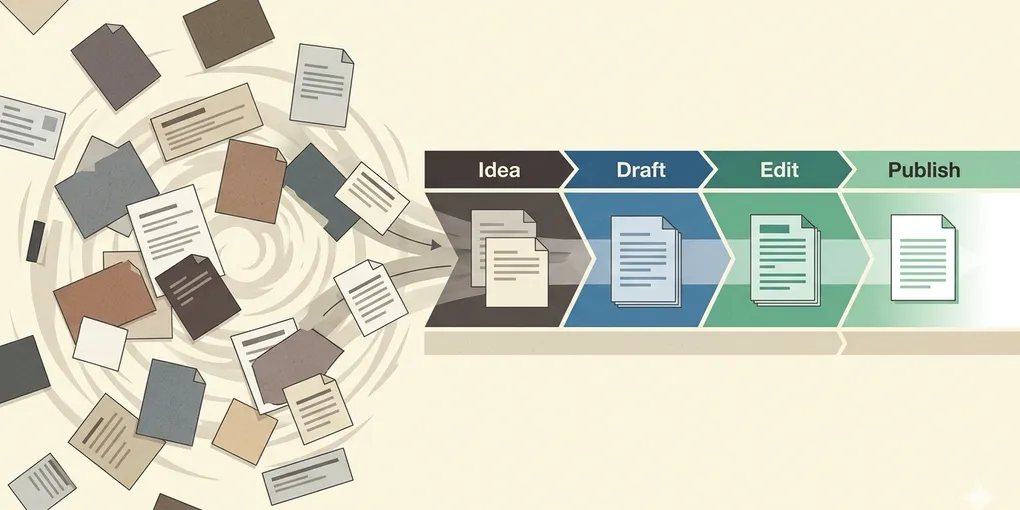
How to manage content stages without drift
Content production systems usually do not drift because writing gets harder. They drift because the stage of each piece becomes implied instead of visible. A draft feels “almost done,” an image is “probably coming,” review is “basically finished,” and publish is “just one more step away.”
That sounds harmless until several posts start moving in parallel. One file is still missing images, another already has images but no review record, and a third has been copied into the real blog path without the ops log being updated. Nothing looks dramatically broken, but the system is already leaking trust.
This post is about making content stages explicit from draft to publish. The goal is not to create more process. The goal is to stop production drift before it spreads across the whole system.
1. The common mistake is treating stage as a feeling instead of a state
Many production systems use stage words informally. Someone says the post is “almost ready,” but that phrase may hide three different realities: the text is done but images are missing, the review is done but the asset paths are not, or the publish files exist but the record still has not been updated.
That ambiguity is what creates drift. The workflow does not break in one dramatic place. It spreads through small assumptions. People stop asking “what is the exact next state?” and start asking “is this close enough?” The second question always makes the system weaker.
2. A clear stage system works only when every state means one specific thing
This is the strongest part of the workflow. A stage is useful only when it answers one operational question clearly: what is done, what is still missing, and what is the next allowed move?
That means “draft” should not mean “almost reviewed.” “Image-ready” should not mean “images are still being discussed.” “Publish-ready” should not mean “we still need to check paths.” Each stage needs a narrow definition, and that definition should be boring enough that two different people would classify the same post the same way.
This is where many content systems drift. They track files, but not completion meaning. So two posts can sit in the same folder while being in very different real states. One is waiting on images. The other is waiting on review. A third is already publishable but still looks incomplete because the stage does not say what is actually blocked.
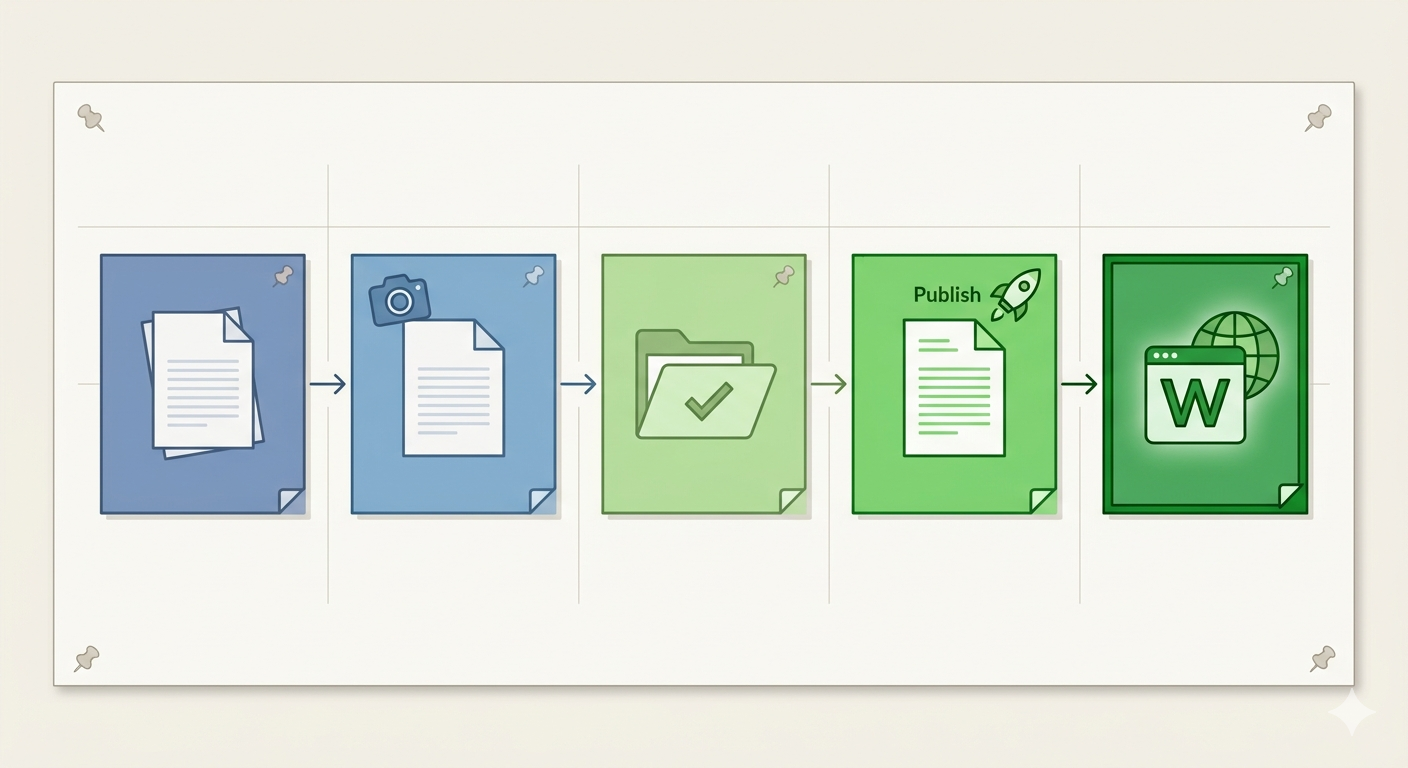
A stronger system makes stage definitions boringly clear. Draft means text still open. Image-ready means image prompts and slot roles are locked, and only generation remains. Review-ready means the post, asset intent, and metadata are stable enough to judge. Publish-ready means the remaining work is mechanical path movement and record sync. Published means the live content paths, generated assets, review file, and operating log all agree.
Once those boundaries are explicit, the whole production loop gets easier to trust. You do not need to remember what “almost done” meant last week. The state itself tells you what kind of work is still alive. That is what turns a content system from a memory game into an operating system.
3. A small stage list is enough
Most content systems do not need many stages. A short sequence is usually enough:
- draft
- image-ready
- review-ready
- publish-ready
- published
Too many states often recreate the same ambiguity at a finer level. If you need eight labels before you can explain why a post is stuck, you probably have naming noise instead of a useful state model.
4. Every stage should expose the blocker, not hide it
The real value of stage management is not naming progress. It is exposing the next blocker. If a piece is stuck, the stage should make the reason obvious.
That is why stage labels work best when they connect to one missing condition: image missing, review missing, metadata incomplete, publish sync pending. A stage that does not reveal its blocker is just decoration.
A good test is this: if someone opens the folder and asks why the post has not moved, the answer should come from the stage label itself instead of from your memory. The system should say “waiting on slot images” or “waiting on review judgment” without needing a side conversation.
5. One concrete example is enough to show the difference
Imagine two posts that both feel “almost done.” In a weak system, they sit side by side with no real distinction. In a stronger system, one is image-ready because the text and prompts are locked, while the other is review-ready because the images already exist and only quality judgment remains. Those are not the same state, so they should not look the same.
Now imagine a third post that has already been copied into the final blog folder, but the review file and ops record still point to the previous draft state. That piece may look finished from the outside while still being operationally incomplete. This is exactly the kind of mismatch that a visible state model prevents.
That difference is what keeps the system from leaking confusion into every later step.
What to do first
Write down five stages only: draft, image-ready, review-ready, publish-ready, published. Then define one exact missing condition for each transition. If you cannot explain why a piece is not moving, the stage system is still too fuzzy.
- draft -> image-ready: text, slug, and image intent are locked
- image-ready -> review-ready: slot assets exist and their role is fixed
- review-ready -> publish-ready: content and quality judgment are stable
- publish-ready -> published: final paths and records are all synced